Breslyn, lives with pLGG, and Noelle, her sister
Tumor shrinkage with OJEMDA
Meaningful tumor shrinkage may be possible with once-a-week OJEMDA
Imagine what tumor shrinkage could mean for your child
0%
More than half of the children with pLGG (40 out of 76) saw tumors shrink by at least 25% in the clinical trial
- 38% of children (29 out of 76) had tumor shrinkage of 50% or more
- No child had their tumor completely disappear
See how families just like yours navigated pLGG with the help of OJEMDA
See how families just like yours navigated pLGG with the help of OJEMDA
ON SCREEN: REAL FAMILIES. REAL EXPERIENCES. EXPERIENCE WITH OJEMDA™ (tovorafenib)
MANDY: Every cancer journey is different. Every child, every family, every response is different. But the underlying theme is that your kid is sick, and you need an option. ON SCREEN: MANDY mother of Gabby who was treated with OJEMDA for 25 months
AARON: We definitely knew that it was, this is sort of like a new chapter that we're moving into. ON SCREEN: TRISTA & AARON parents of Olive who was treated with OJEMDA for 25 months
REEBA: I was hopeful, but I was terrified, as I always am. ON SCREEN: REEBA mother of Myla who was treated with OJEMDA for 25 months
MANDY: We had put all these hopes into this opportunity, this, this chance.
ON SCREEN: Designed for Kids
MANDY: It's overwhelming with all the information they give you, and it is, it is information overload, no doubt. But if you can just take piece by piece, and sort of latch on to that, you know, Gabby's tumor mutation is the KIAA1549 BRAF fusion mutation – I know it's a mouthful, but it's important to know those little details.
TRISTA: When Olive had a sample taken of her tumor,
AARON: we weren't really sure if there would be enough sample collected to really tell, you know, if she would qualify for this trial or what.
TRISTA: But they were able to determine that she had changes in the BRAF gene, and that cleared us for being a part of the study.
REEBA: The last piece that really, really made probably the biggest impact for me is OJEMDA was made for kids.
ON SCREEN: What is OJEMDA™ (tovorafenib)?
OJEMDA is a prescription medicine used to treat certain types of brain tumors (cancers) called gliomas in people 6 months and older:
• that is a pediatric low-grade glioma (LGG), and
• that has come back after previous treatment or has not responded to previous treatment, and
• that has a certain type of abnormal "BRAF" gene.
Please see full Important Safety Information at the end of this video.
MANDY: This drug was tested on kids, for kids. It's not been a modified dose from adults. ON SCREEN: OJEMDA was studied in FIREFLY-1, the largest clinical trial of children with BRAF gene changes. The FIREFLY-1 trial concluded at the end of 2024.
AARON: I think the excitement that our care team had, to see them excited about getting Olive into a trial, gave us a lot of peace of mind.
ON SCREEN: Developing a Routine
TRISTA: The overall treatment plan was manageable and it meant so much for us for Olive to be able to take
TRISTA: the medication once a week, at home, with or without food. ON SCREEN: OJEMDA can be taken:
• once weekly
• at home
• with or without food
• as tablets or liquid
TRISTA: We weren't going to the hospital every week. It was amazing.
MANDY: We really appreciated was the fact that you could take it at home, once a week. And it wasn't that constant litany of being stuck in the hospital and doing all those things.
TRISTA: She would take her medication every Friday morning before school, for the length of the trial.
AARON: She had hype music. There was dancing. It was a pretty exciting event.
REEBA: It meant we did not have to schedule when we were going to the hospital to go get her therapy. We could actually do it at home, once a week.
ON SCREEN: Seeing Results
REEBA: While Myla was on the trial, we would go in to the hospital so that she could be regularly monitored. We went in every three months to get an MRI scan. When you're dealing with pLGG, every single scan is nerve wracking. You don't sleep the night before, you're so worried about the results, there's no way for you to know what's gonna come up on those scans.
MANDY: I remember being really anxious about that, that first scan on the drug, and, but yeah, hopeful that we were going to see a good, a good answer.
AARON: Between the MRI and when you get the results, it, it's like an exercise in not thinking about it.
TRISTA (heard off-camera): Yeah. ON SCREEN: OJEMDA may cause serious side effects, including bleeding problems, skin reactions, including sensitivity to sunlight (photosensitivity), liver problems and slowing of growth (height).
AARON: At least for us, right? I don't think that we're sitting there like, wringing our hands. We're like, how do we distract ourselves until that moment when the door opens and they pop the head in and they say,
TRISTA: It’s great.
AARON: Things are better.
TRISTA: Yeah.
MANDY: When we got the report that said there was slight shrinkage, we just, we were over the moon. We were just, felt like we're on the right path. ON SCREEN: In the clinical trial for OJEMDA, 51% of children (39 out of 76) saw their tumors shrink by at least 25%
REEBA: The doctors came into the room and the look on their faces kind of said it all. Myla’s tumor had shrunk after only three months on the trial drug. ON SCREEN: 46% of children (18 out of 39) saw tumor shrinkage at 3 months after their first MRI scan* *These data were collected during the clinical study, and additional analyses were done. These results are not in the OJEMDA Prescribing Information.
TRISTA: When they popped their head in and just told us, “Great,” like “Good news”, ON SCREEN: 50% of children (20 out of 39) saw tumor shrinkage at 5.3 months
TRISTA: I just felt like ok, we can relax right?
AARON: Kind of an exhale of, you know, tension that you're holding that you didn't know you were even really holding.
TRISTA: Yeah. So it makes us that much more proud that our daughter was a part of that.
ON SCREEN: Side Effects
AARON: So when we make treatment decisions, we weigh out side effects, we do research, we work with our care team.
REEBA: We had an amazing care team who we trust so much. And they started to talk to us a little bit about the side effects.
REEBA: What they could tell us, was information that we could kind of wrap our heads around, and we felt comfortable with it. So we decided to trust the care team once more and decided to go ahead and give the trial for OJEMDA a shot. Myla did have some side effects while on OJEMDA. She had a rash on her body and on her face.
AARON: I think it was a couple weeks in when she started to get the rash. ON SCREEN: The most common side effects of OJEMDA include:
• rash
• hair color changes
• feeling tired
• viral infection
• vomiting
• headache
• fever
• dry skin
• constipation
• nausea
• acne
• upper respiratory tract infection
TRISTA: As a part of the home treatments for Olive's rash, we did a lot of bleach baths, which sounds wild, but it's just a bath with a little bit of bleach in it. ON SCREEN: Rash typically appeared 2 weeks after the first dose and up to 16 months after.
AARON: She was not a fan.
TRISTA: Not a fan, especially not a fan of doing all the, like, creams afterward.
AARON: In addition to the rash though, right, she had pretty severe sun sensitivity. Lots of hats. Lots of sunscreen.
TRISTA: Which she hated.
AARON: Which she hated.
REEBA: Myla did have slowed growth, and she would get nauseous and would throw up a lot when she was really hot.
MANDY: Gabby experienced rash, nausea, vomiting, fatigue, and perhaps most noticeably, hair color change. But, she took that change of hair color just like anything else, and she just rolled with it.
REEBA: The hair color change was, was an impact. It didn't bother her as much. I will say her eyebrows and her eyelashes did bother her. She felt a little strange about those. ON SCREEN: These are not all the possible side effects of OJEMDA. Call your healthcare provider for medical advice about side effects.
ON SCREEN: Words of Encouragement
REEBA: At the start of this journey, I was lucky enough to be able to give one of my cousins a call who's in the medical profession. And the best piece of advice that she gave me, and that I would tell you, I would pass on to anyone who was starting down this path, is to make sure you are an advocate for your child.
TRISTA: I would say you're your child's biggest advocate. If you have questions, please ask them. Like, do not be afraid to get all the information you need to be able to feel confident moving forward.
MANDY: You know, if I was sitting with another mom and, or if it was me just sitting there for the first time with this diagnosis, and you feel very alone, but know that your one voice can make a huge difference, not just for your child, but for other families.
Are you considering talking to your child’s doctor about OJEMDA?
A Guide for Considering OJEMDA
Interested in learning more about OJEMDA treatment? Explore clinical trial results, possible side effects, and available patient support tailored to your family’s needs.

“We got the report that said there was slight shrinkage and we were over the moon. We felt like this is the right path.”
—Mandy, mom of Gabby. Gabby was treated with OJEMDA for 2 years in the clinical trial.
50% of children (20 out of 40) saw tumor shrinkage at almost 5.5 months after starting OJEMDA
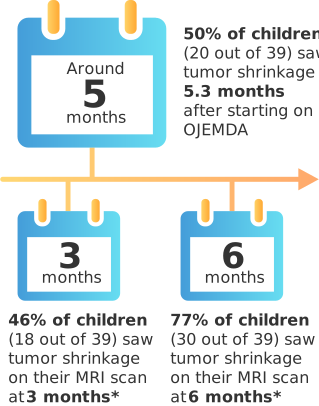
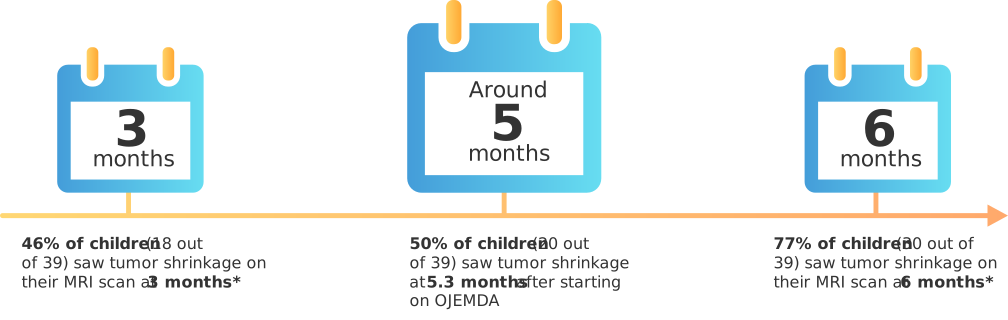
Results were measured with MRI scans every 3 months.
*These data were collected during the clinical study, and additional analyses were done. These results are not in the OJEMDA Prescribing Information.
How long did children maintain tumor shrinkage?

At the time of study evaluation, half of the children (20 out of 40) who experienced tumor shrinkage continued to see measurable shrinkage for 18 months.
57% of children (44 out of 77) completed 2 years of treatment with OJEMDA at the time of study evaluation on May 10, 2024.
“I still can’t believe how quickly we saw results with OJEMDA.”
—Trista, mom of Olive. Olive was treated with OJEMDA for 2 years in the clinical trial.
Watch Reeba discuss her daughter's journey with OJEMDA
Watch Reeba discuss her daughter's journey with OJEMDA
Hi everyone, I’m Reeba, and I’m here today with my daughters, Myla and Ava. Today, we want to share Myla's journey with you
No one is ever prepared to hear that their child has a brain tumor. The news is confusing and terrifying, and you have so many questions. You just don’t know what the future will hold
But I can tell you from experience that with a medical team you trust, and the help of family and friends, and asking a lot of questions, you and your child will find a way through a diagnosis of pediatric low-grade glioma
I’d like to introduce two key members of the team who took amazing care of Myla, Bridget and Dr Landi
Hi, I’m Bridget Archambault, and I work at Duke Cancer Center along with four pediatric neuro-oncologists
TAs the sole nurse practitioner with the program, I have become the primary person providing continuity of care for all the patients who are on targeted therapies
I got to know Reeba and Myla in 2016 when Myla was receiving chemotherapy, and we’ve been very close since then because I see a lot of the patients when they come in for routine treatment and imaging
Hello. I am Dr Daniel Landi, one of the pediatric neuro-oncologists with the Preston Robert Tisch Brain Tumor Center at Duke in Durham, North Carolina
I joined Duke in 2017 and soon joined the team taking care of Myla, and Myla and her mom and dad have really welcomed us into our family
Reeba, why don’t you tell us a little bit about Myla and her pLGG journey
Sure, thank you, Dr Landi. Everyone has been so dedicated to Myla and helping us through this journey
It all started with her check-up when she was actually 15 months old
Myla was born on December 22, 2012. And I was a first-time mom, so I made sure that she saw the pediatrician regularly. I went to every scheduled visit as I was supposed to
She was growing; she was really bright, she…, her hand-eye coordination was great
The only thing the doctor kind of pointed out to us was that her head was big for her age. We also knew that at that point, at 1 year old, she still wasn’t walking yet, which was a concern
She was adopted, but we kind of joked anyway that she got her father’s head because her dad has a really large head
At her 12-month appointment, the pediatrician put Myla on physical therapy, simply because some kids just need a little help getting started walking, and we thought that’s all it was
She hated PT. She would just lie there and cry and not do the exercises
But then, at her 15-month appointment, her head had grown so much that the doctor told us that we needed to immediately go get a CT scan. I didn’t even know what a CT scan was at that point
After the scan, they told us she had hydrocephalus; again, a word I had never heard before
We eventually ended up in the ER, and they did an MRI
At that time, I was 8 months pregnant with Ava, and the doctor kept telling me to stay calm. He didn’t want me going into labor when he delivered the news that he needed to give us
I’m typically a really kind person, but in that moment, I probably wasn’t very kind; I probably used some expletives. I just wanted him to tell me what was happening. I was so confused, and I didn’t understand it
I’ll never forget the words he said to me when he said: “Your very tiny daughter has a very large brain tumor, and we’re going to need to operate, immediately”
I gotta tell you, I couldn’t really believe or really understand what I was hearing. You know, in our minds, Myla just couldn’t walk. I mean, that was all that was wrong with her, right, at that point. We didn’t really get it, but when the surgeon said that this was serious and then when he told us, “You guys need to call your families, everyone needs to come in,” I think that’s when it really sank in
And I remember just before the surgery I went to the surgeon, and I asked him if he’d had a good night’s sleep and I asked him if he’d fought with his wife, because I just wanted to make sure he was in a really good frame of mind before he operated on Myla. And of course, he was. He did an amazing job
He removed almost all of the tumor, and he inserted a shunt to drain the fluid around her brain. And after that, there was just so much to learn about this tumo
Thank you for sharing that, Reeba. It’s an incredible story, and I’ve heard and been a part of this story
I would add that, you know, pediatric low-grade glioma, the type of tumor that Myla has, is the most common type of brain tumor that we see in our children. It’s the most common central nervous system tumor in kids
Sometimes these tumors can be removed surgically, but oftentimes they can’t due to the location
Unfortunately, about half of patients see their tumors get worse after the first treatmen
Bridget, what kinds of symptoms have you seen in our patients who are diagnosed with pediatric low-grade glioma?
Yeah, kids and teens with pLGG often have problems with their vision, movement, thinking, and daily activities, depending on where the tumor’s located
Each treatment, including surgery, can increase the risk of long-term issues
Myla’s tumor is in a place where it didn’t affect her speech or vision, but it blocked the flow of the fluid around her brain. That pressure could have eventually caused problems, as well
Reeba, tell us what happened after Myla’s first surgery
Yes, so, 3 months later, about a week after I’d given birth to Ava, we brought Myla in for her 3-month check-up. She was doing so well. She was happy; she wasn’t upset about PT anymore – she was doing all the exercises. So, we actually were planning on celebrating by going to get her new shoes, because we knew everything was great, we were going to get a great check-up
But instead, we were devastated to hear the news. The tumor grew back fast and large. She needed another surgery, and she was going to have to start chemotherapy
Starting chemo was really hard, shuttling back and forth between the hospital, trying to breastfeed, caring for my newborn, Ava, and still trying to spend enough time with Myla, right; it was just a tough time
Luckily, Myla really loved her “Duke days,” as she called them. She loved the nurses, the doctors would come in and joke with her, but she did experience some side effects, including an allergic reaction to one of her treatments
That happened, luckily, when we were at the hospital, and thankfully, her treatment team jumped in right away
Most options available to treat pLGG, including chemotherapies and certain targeted therapies, are only approved by the FDA for use in adults
While surgery, chemotherapy, radiation, and targeted therapies may be effective treatment options, it is important to know that they can also have lifelong impact on a child’s quality of life
Some treatments may need to be taken once or twice a day or even require a child to go to a treatment center to be administered
Do you remember some of our discussions about Myla’s treatments?
Yeah, absolutely. Her treatment plan was changed a couple of times, right, and every time it was, I had the same questions, right:
- What are the side effects going to be?
- How long will she be on it?
- And how often will she need to take it, and do we need to come to the hospital for those doses?
Myla would throw up a lot, especially if she got really, really hot. I tried to have sick bags with me all the time, and I still have some in the backpacks that I carry, just out of habit
Getting her to the treatment center was another really big commitment, right. That’s where we had to go for her doses at that time. My ex-husband and I were both working, and so we would swap kinda taking Myla
And then in 2018, Dr Landi suggested another possible option
Right, so in 2018, Myla’s tumor had progressed again, and we needed a new approach, so we offered another targeted therapy available at that time
Targeted therapies can target and attack tumor cells with specific characteristics
IAt that point, Myla could swallow pills, so this medication was an option, but after a year and a half on that treatment, in 2021, we had to tell Reeba that Myla’s tumor had grown again
Yeah, hearing that, my mind just raced. It was so hard to listen to what you guys were saying. The news came at a really tough time, too. I had just started a new job, and my husband and I were both… were going through a divorce
So, I remember asking you guys what the options were, right, I just… I figured the only option was going to be chemotherapy
And that’s when you, Dr Landi, told me about a clinical trial of a targeted drug designed for children, which is incredible
It was terrifying to think that Myla would be patient number 30 on this completely new drug. It was early in the trial, and nobody really knew what to expect at that point
You did tell me about the side effects that were already known, and that it was a 2-year trial, so I could kinda wrap my head around knowing that treatment would stop sometime in June 2023
We also knew that Myla could swallow pills and this was an oral drug taken once weekly. That was a huge relief to us, because there were no more weekly trips to the hospital, as much as we loved seeing you all
We have so much trust in this team, and so we agreed to have her go on the study
Bridget, you can probably say more about why this trial was a good fit for Myla
Yeah, Myla was a good candidate for this study for several reasons, including the type of tumor she had
Her tumor showed an alteration in a specific gene, called BRAF, which causes cells to grow into tumors. The majority of patients with pediatric low-grade glioma have a BRAF alteration in their tumor
The drug being tested, tovorafenib, was designed to specifically target BRAF alterations in pediatric low-grade glioma
That’s right. And so tovorafenib was studied in the trial called FIREFLY-1
Tovorafenib went on to be approved by the FDA and is now called OJEMDA
OJEMDA is a prescription medicine used to treat certain types of brain tumors called glioma in patients 6 months and older:
- hat is a pediatric low-grade glioma
- has come back after previous treatment or not responded to previous treatment and
- that has a certain type of abnormal “BRAF” gene
OJEMDA is available in tablet or now liquid form
Based on the study evaluation, we know now that 51% of the 76 children who participated in the trial saw their tumors shrink by at least 25%
Children on the study had an MRI every 3 months. And during the first MRI, at 3 months, 46% of children saw tumor shrinkage. During the second MRI, at 6 months, 77% of children saw their tumors shrink
We saw Myla’s tumor shrink at the very next MRI, right after we started. Not everyone in the clinical trial had the same results, but Myla’s tumor shrank, and it stayed stable, which is amazing
After she finished 2 years on OJEMDA, our team suggested that we stop therapy. That was last June, and since then the tumor has not grown at all
While she was on OJEMDA, though, we did need to turn to the care team to help with some side effects
Bridget, you’ve helped manage side effects for our many of our patients on OJEMDA. Could you describe some of the strategies that you used?
Yeah, sure. We know now that OJEMDA may cause serious side effects including bleeding problems; skin reactions, including sensitivity to sunlight; liver problems; and slowing of growth
The most common side effects are rash, hair color changes, feeling tired, viral infection, vomiting, headache, fever, dry skin, constipation, nausea, acne, and upper respiratory tract infection
Reeba, tell us how Myla did with the side effects
So, Myla’s hair did turn completely white, and everywhere we went people commented on it. They would always, um, either compliment it or they would ask her, “Does your mom let you dye your hair like that?”
She also, though, did have some pretty severe skin reactions, and we did have to learn how to manage some of those
And you actually came back to me and said it had really helped. In addition, we’d given Myla a topical antibiotic for some of her skin lesions that she’d had
Myla also shared with us what she was feeling and what her body was telling her, which was a big thing in knowing how to treat her
Additionally, OJEMDA can affect growth, and Myla’s growth was impacted while she was taking tovorafenib during the clinical trial. She is a good example of someone whose growth has recovered
After Myla stopped her treatment, we noticed she was growing again in about 3 months, and really by about 9 months she was catching back up
What has being on OJEMDA meant for you and Myla?
Myla’s entire life has been about getting treatments and seeing doctors, but she understands that by being on this trial, she helped contribute to something really, really important
I said to her, “You made history.” You were literally making history by being on this trial. It went to the FDA. It got approved. There are now other kids who are going to be able to take this now
Reeba, you and Myla have experienced so much and come so far. What would you say to other families going through the same thing?
You know, I guess, to start, the best advice I got came from my cousin. She is a pediatrician, and her child also had some medical issues when he was a baby, and she told me that I need to be Myla’s advocate. Nobody will know Myla as well as I do, and I should never hesitate to ask questions and protect Myla
Um, for example, I know it’s a teaching hospital. But I also say it’s my daughter. Right? So, you… what I tell people is, you get two chances to give her an IV. If you can’t get it in, then we either go find someone else to do it or just go get the ultrasound machine, right
And you can do that respectfully but being that advocate for your child and realizing that you know your child better than anyone else at that hospital because you’re with them day in and day out, that is so important. And that was probably the biggest piece of advice I got
Also, do research to find a care team that you trust. You need to be able to trust in their advice and their recommendations
And then, I would tell you, ask the questions. Of everybody, all the time, because everybody has a different perspective and different types of knowledge that can kind of help you
Thank you, Reeba, for sharing that
Reeba’s and Myla’s willingness to share with others, with other families, and to connect and share their journey has really made a difference
We have an annual fundraiser walk and Myla was out there with her white hair and her hat and her sun protective clothing, and she noticed another little girl who also had white hair and a hat. And they connected when they realized that they must be on similar treatment and have gotten together since. That’s just who Reeba and Myla are in this journey, wanting to touch others on a similar journey as well
Really wonderful that you do share your journey and help others in this way. You know, you’re a tough act to follow, and I’ve heard you talk about Myla and your journey together
You know, I have twin boys, and I think seeing other parents navigate a journey like you and Myla have been on colors my own experience as a parent where, even though my sons don’t have a brain tumor, my goal is to always be honest with them but also to be their advocate. And, at the end, I think probably what most of us as parents want is for their… their children to have intact medical, physical, and emotional well-being. And I think that you and Myla have weathered this journey beautifully, and it’s kind of you to share it with us
OJEMDA has helped shrink Myla’s tumor, and I think, by and large, OJEMDA has been helpful managing other patients’ tumors
rue. Thank you for helping me share Myla’s and my story
